The Freedman’s Bank Betrayal: America’s First Broken Promise of Black Wealth
How Congressional Negligence, Financial Mismanagement, and Racial Politics Destroyed Black Savings—and What Reparations Are Owed Today
By: Omari Bakari
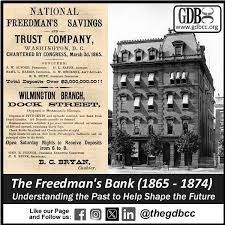
In 1874, less than a decade after emancipation, the collapse of the Freedman’s Savings and Trust Company—commonly known as the Freedman’s Bank—marked one of the earliest and most devastating economic betrayals of newly freed African Americans. Chartered by the U.S. Congress in 1865, the bank was promoted as a safe place for formerly enslaved people to deposit their hard-earned savings. More than 60,000 Black depositors, many of whom had never before been allowed to own money, trusted the institution with nearly $3 million—capital intended to buy land, start businesses, educate children, and secure independence from exploitative labor systems. Instead, due to reckless speculation by its white-led board, lack of federal oversight, and the broader unraveling of Reconstruction, the bank collapsed, wiping out generations of Black economic hope at the precise moment it was most fragile.
The nature of the harm was not accidental. Although Congress chartered the bank, it failed to regulate or supervise it. Trustees invested depositor funds in risky railroads and real estate ventures, often for personal benefit, violating the bank’s original mandate to hold funds in safe government securities. When the Panic of 1873 struck, the bank’s already weakened portfolio collapsed. Congress, fully aware of the mismanagement, chose inaction. This failure of governance constitutes state-enabled financial harm, making the federal government complicit in the losses suffered by Black depositors. While white-controlled financial institutions were stabilized and protected during economic crises, Black savers were abandoned.
To determine the value of reparations owed, the harm must be measured using clear, defensible metrics. The first metric is direct financial loss. The $3 million lost in 1874 equates to roughly $70 million today when adjusted for inflation. But inflation alone understates the damage. These funds represented first-generation post-slavery capital—money that, if preserved, would have compounded over time. Applying conservative wealth compounding rates of 4–6 percent over 150 years produces an estimated $3 to $6 billion in lost generational wealth.
A second metric is denied land ownership. Historical records show many depositors intended to use their savings to purchase land. If even half had acquired modest plots, hundreds of thousands of acres would have entered Black ownership during Reconstruction. At today’s land values, this denial represents an additional $1 to $2.5 billion in lost wealth. A third metric addresses suppressed business formation. The bank’s collapse eliminated startup capital, forced reliance on predatory credit, and reinforced economic dependency, costing Black communities an estimated $1 to $2 billion in unrealized enterprise growth.
Finally, there is the metric of institutional trust damage. The betrayal fostered deep, rational distrust of banks within Black communities—reducing participation in formal finance, increasing borrowing costs, and slowing wealth accumulation for generations. Economists recognize this as a measurable drag on asset growth, conservatively valued at $2 to $4 billion. Taken together, these metrics place the reparations owed for the Freedman’s Bank collapse between $7.3 and $14.5 billion, with a reasonable midpoint of $10 to $12 billion.
The Freedman’s Bank did not merely fail—it was allowed to fail. Its collapse illustrates how Congress protected white financial institutions while sacrificing Black economic security. Reparations are not about sympathy; they are about accountability. The damage was real, the losses measurable, and the debt long overdue.
Journal